

On a Saturday night in November, the Gettys Center in downtown Rock Hill, South Carolina was filled with artists. Twenty-four of them wore handmade name tags pulled from a banner near the door — proof, in a quiet way, that they had come. Pie was five dollars a slice. A musician played blues and cotton mill music. This was the closing night of Art Party, a four-day festival that brought poetry, film, performance, and an art stroll through sixteen downtown businesses to a suburb of Charlotte. By every visible measure, the evening was a success.
What is not visible at Art Party is the thirteen years of patient asking that have gone into convincing churches and friends to fund something most of them do not quite know how to measure.
Arts ministry may be one of the hardest things in American Christianity to fund. Not because it doesn’t work — but because it doesn’t fit the metrics most donors have been trained to ask for.
Two Cru staff, one arts organization, and a careful distinction
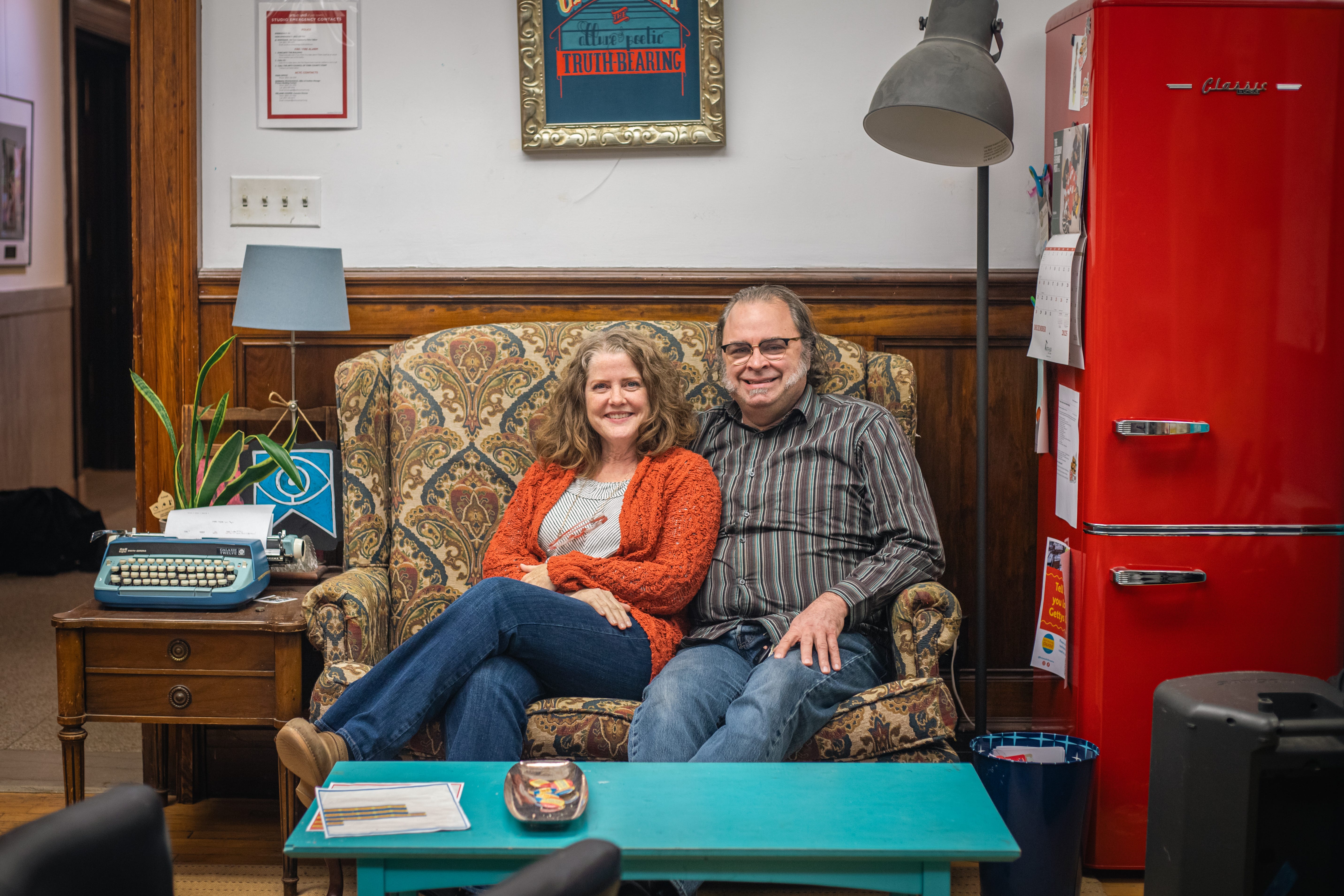
Kirk and Sarah Irwin have been on staff with Cru since long before they arrived in Rock Hill in 2013. They run Friday Arts Project, an organization that serves the artists of Rock Hill regardless of what those artists believe.
Friday Arts Project is not a Cru ministry. The Irwins are careful about this. Cru staff lead it; a Cru staff couple shaped its current form. But the organization itself is a secular arts nonprofit, and that was a deliberate choice made in the Irwins’ first year on the ground.
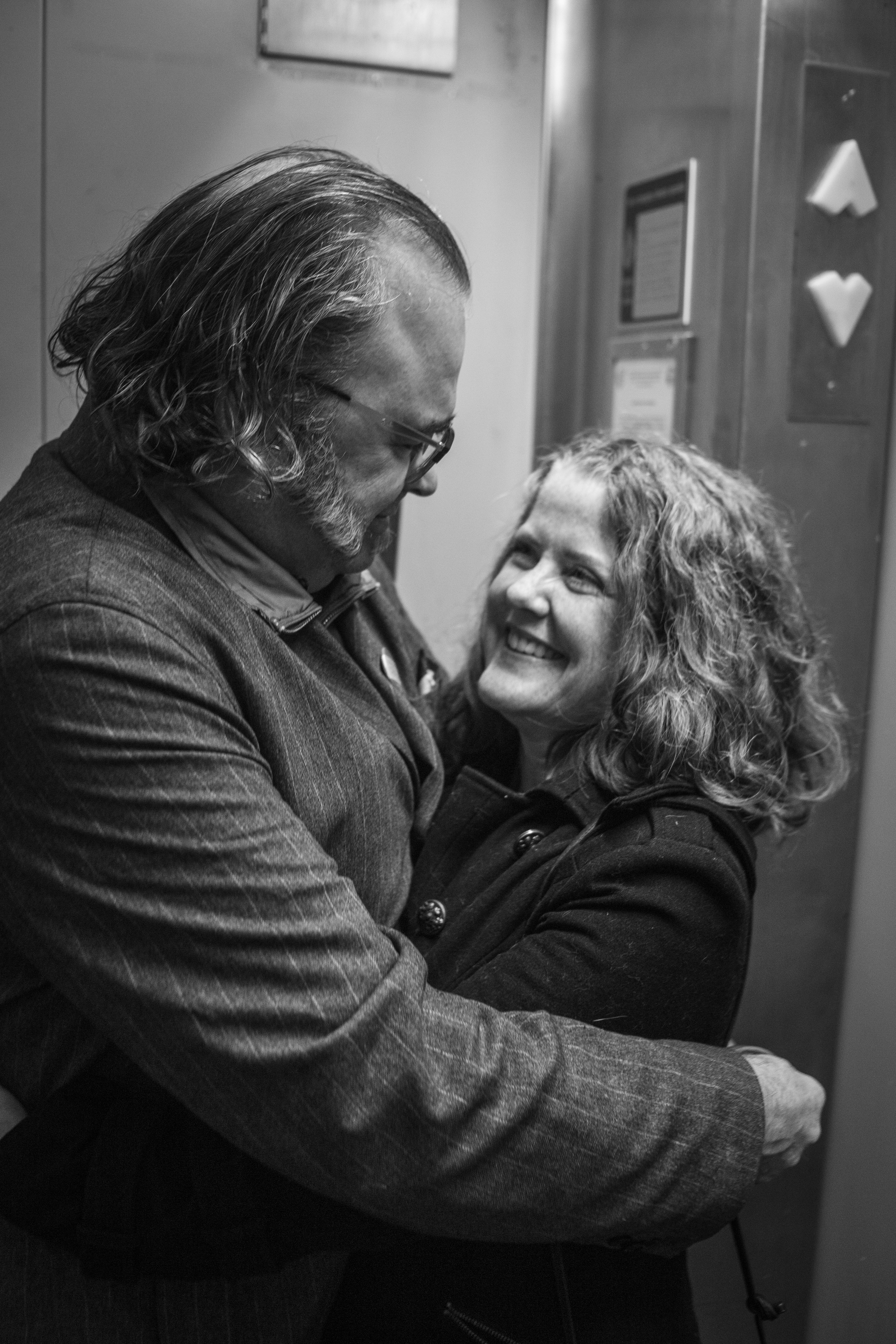
Kirk and Sarah Irwin at the Gettys Center
Photo by Michael Tolosa
The story behind it begins in New York, where Kirk spent ten years on Cru’s Metro Team and met Makoto Fujimura, the painter and founder of the International Arts Movement. After 9/11, the conversation between faith and art in New York grew louder, and Kirk found himself working in two worlds at once — Cru staff by day, sitting on Mako’s board by night. In 2006, illustrator Stephen Crotts, a Winthrop University student at the time, attended a Cru summer project in the city, caught the vision, and brought it home. He and a few classmates kept it alive after they graduated, renting an unfinished floor above Amélie’s bakery and inviting other artists in. By the time Kirk and Sarah arrived from Florida in 2012, there was a small organization waiting to be formalized.
In their first year, the Irwins and the people around them spent months wrestling with one question: should this be a Christian arts organization, or a secular arts organization? They chose the latter. “Once you set up a Christian arts organization,” Sarah says, “that’s who you’re going to get.” They wanted a wider table.
The two-level fundraising problem
What they gained in the wider table, they lost in the support letter.
Kirk talks about fundraising in two levels. The first is making the case for ministry at all — for why a salary should be raised so a person can do gospel work full-time. The vocabulary for this level already exists in the church. Conversions. Bible studies. Students reached. Cards designed. Sarah, who began her Cru career as a graphic designer, says it was easier to raise support then than it is now: she could point to evangelistic tools she had made and to the students they had reached. The receipts were short, and donors recognized them.
The second level is harder. It is making the case for arts ministry specifically — for why beauty is worth funding when the impact will not show up on this year’s report.
“How do you measure the impact of Vincent Van Gogh’s sunflowers?” Kirk asks. The question isn’t rhetorical. He has been asking it of donors and pastors and supporters for more than a decade. He likes to tell the story of Peter Hitchens — brother of the famous atheist Christopher — whose return to Christian faith was prompted in part by encountering a five-hundred-year-old altarpiece by Rogier van der Weyden. The painter had no idea, in the 1400s, that his work would still be preaching in the twenty-first century. He could not have. That is the timescale arts ministry operates on, and it is not the timescale of a quarterly giving statement.
“Make disciples” with no qualifier
If a donor were to press the question of what, exactly, their giving funds, Kirk would not promise conversions. He would describe what he discovered in a diagram called the Gray Matrix — a tool that maps a person along two axes: how much they know about the gospel, and what posture they hold toward it. Movement on either axis counts. Most of the movement in his community is on the second axis.
He thinks of one artist friend, a man whose work and friendship the Irwins have valued for years. The friend was openly suspicious of the Christianity in their circle when they met. After more than a decade of shared events and shared tables, he told Kirk, “I’d work for you guys if you had money to pay me.” He has not professed faith. But he is meaningfully less hostile to the people who hold it than he once was. In the art world, Kirk says, that is not a small thing.
There is also the couple — together for many years, never married, both nominally distant from church — who quietly walked into a friend’s congregation one Sunday morning without ever asking a question first. The Irwins did not know they were going. They still do not know whether the couple has gone back. But something moved.
When Jesus told his followers to make disciples, Kirk argues, he did not qualify the instruction with a clause about who was already interested. Art creates space for God to work. That is the sentence the Irwins keep coming back to. The work of Friday Arts Project is to keep that space open.
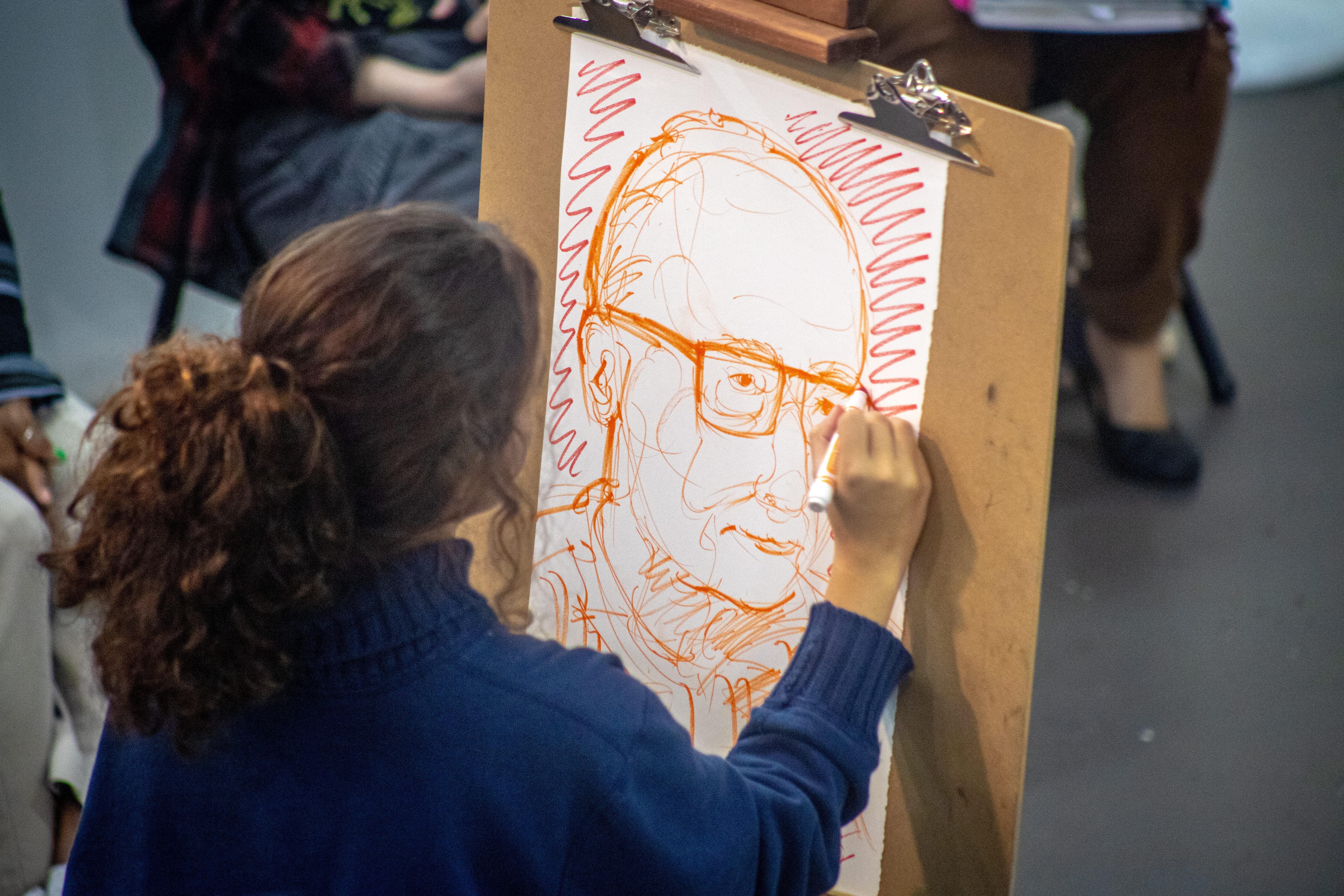
A local artist participates in the Art Party competitive portrait drawing event.
Photo by Michael Tolosa
The visible tip of the iceberg
Art Party is their most visible event. For four days last fall, Friday Arts Project hosted a poetry open mic, a film night, a performance evening, and a closing Shindig. Twenty-four juried artists hung twenty-seven pieces across sixteen downtown businesses — art in barbershops and record stores and brewing companies rather than behind gallery glass. Five different arts organizations sit on the planning committee. Friday Arts Project, as Kirk likes to put it, is the stage manager. The local arts community performs on the stage they build.
What that stage represents is harder to see. Thirteen years of weekly drawing nights and Friday morning conversations at a local cafe. Years of being trusted by a city that knows exactly who the Irwins are and what they believe, and that has come to count on them anyway. The kind of citywide trust Art Party reveals cannot be built quickly. It cannot be built loudly. And it cannot be built at all without funding that is willing to wait for it.
The building question
That trust is being tested now. The Gettys Center, where so much of the local arts community has gathered for years, is up for sale. A grassroots effort called Keep Rock Hill Creative — its branding design done by Sarah — has been showing up at city council meetings, asking the city what its plans are for the arts. The Irwins are quietly hoping that a building with studio space might be made available because the artists they serve have nowhere else to go. “We get the sense that God wants us to walk the path of trusting him for a space,” Kirk says, trusting God as they seek His will.
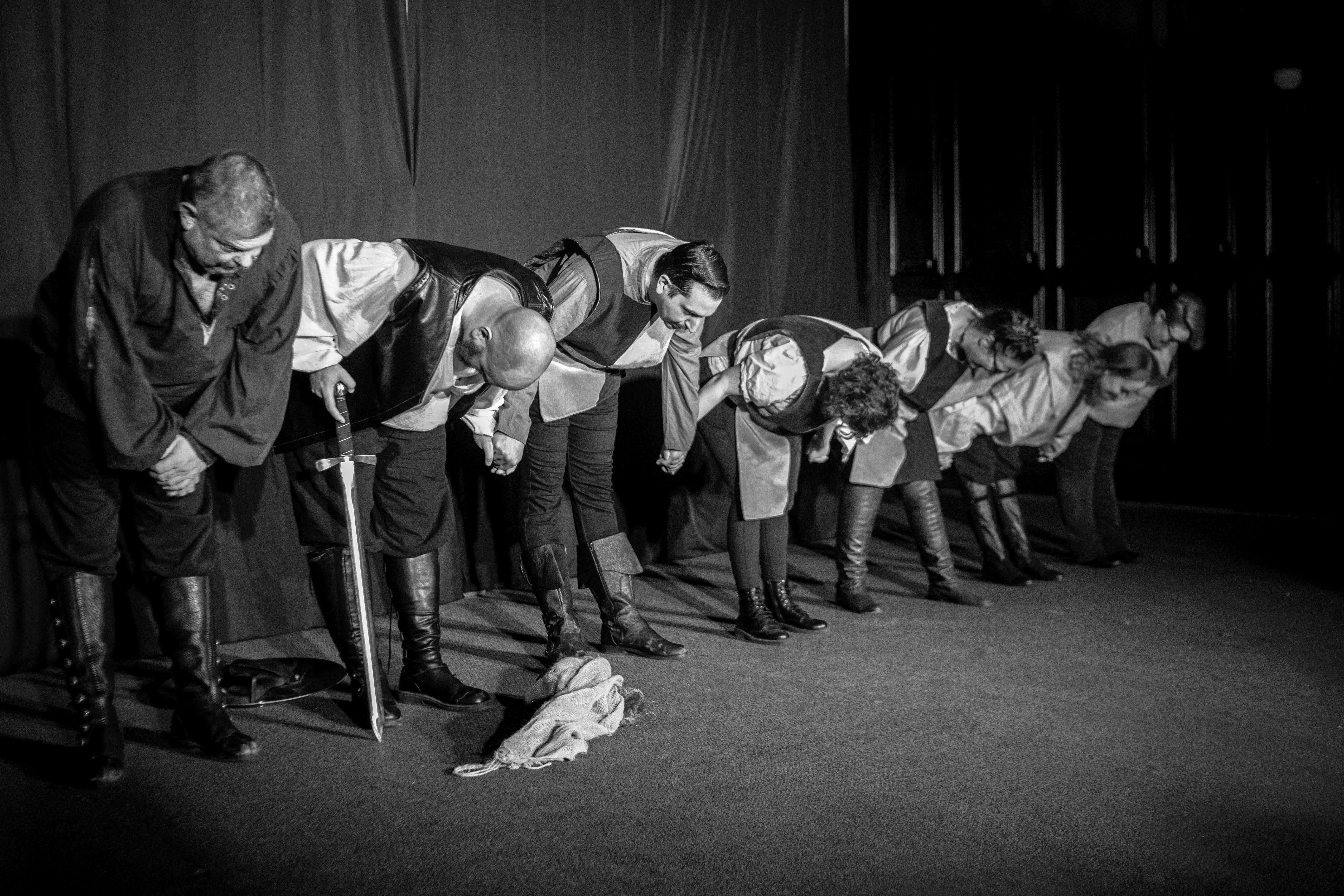
The Free Reign Theatre Company performing great fights of literature at Art Party.
Photo by Michael Tolosa
The five-hundred-year frame
Years ago, on a trip to Washington, Kirk sat in a room full of patrons and artists who had gathered under a five-hundred-year-old Japanese screen. Mako Fujimura, who was speaking, pointed up at it. The artist who painted that screen, he reminded the room, could not have imagined the conversation now taking place beneath it. He had simply done the work in front of him.
The church is fluent in measuring quarters. God works in millennia. Most of what Kirk and Sarah do will not show up on a dashboard this year, or next, or perhaps in their lifetimes. That is the nature of the work, and they have made peace with it. What they need are partners who can make peace with it too.
Friday Arts Project continues because of friends who have decided that beauty is worth funding even when the receipts come slowly. Those willing to come alongside the Irwins directly can partner with them financially, or give to the broader work they are part of — Cru’s national investment in Arts and Culture. It is a quieter kind of giving than most, but the kind that the long game requires.